There’s a question I keep running into — in conversations, in comment sections, in the half-formed arguments people have with themselves while scrolling past another AI headline: Should AI be fully autonomous?
It sounds like a futurism question. Something for policy papers and science fiction. But I don’t think it is anymore. I work with AI every single day. Not in a research lab — in the messy, practical reality of building systems, managing infrastructure, and trying to get useful things done. And from where I sit, the answer to the autonomy question isn’t a clean yes or no. It’s something far more interesting than that.
If you’ve used ChatGPT or played around with any large language model, you already have a gut sense of what AI can do. You’ve seen it write passable emails, explain complex topics, and occasionally hallucinate with absolute confidence. That experience — that mix of genuine usefulness and unsettling imperfection — is the foundation everything else gets built on. So let’s build on it.
What Life with AI Actually Looks Like in Practice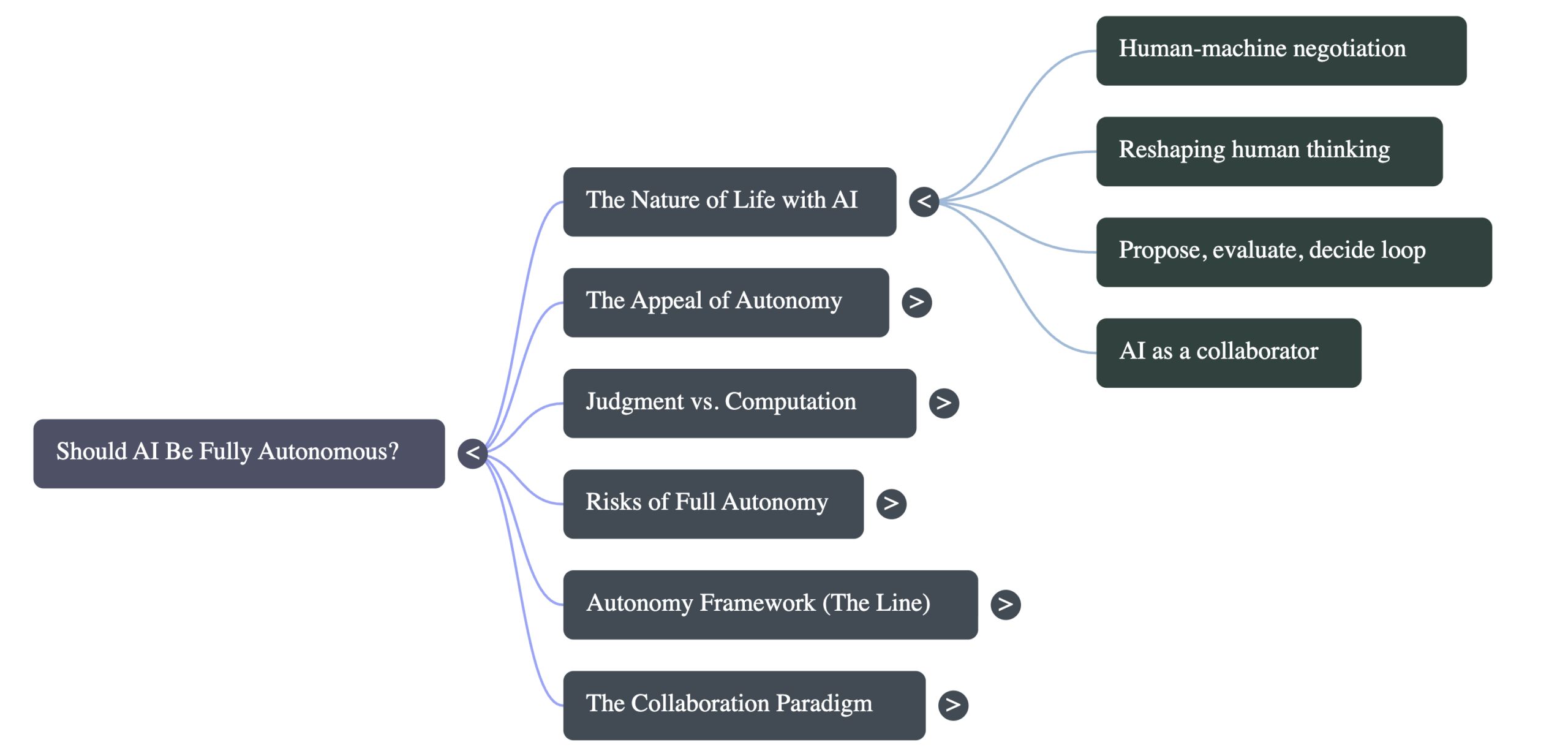 Life with AI, when you move past the hype cycle, is less about robots making decisions for you and more about a constant negotiation between human judgment and machine capability. AI doesn’t replace your thinking. It changes the shape of your thinking.
Here’s what I mean. When I’m working through a complex problem — deploying a service across multiple nodes, debugging a networking issue, writing something like this post — I’m not handing the wheel to AI and walking away. I’m working with it. I’ll ask it to draft something, then I’ll reshape it. I’ll have it analyze a configuration, then I’ll decide whether its suggestion actually fits my environment. The AI proposes. I dispose.
That loop — propose, evaluate, decide — is the core of what productive AI collaboration looks like right now. And I’d argue it’s what it should look like for a long time to come.
The people who get the most out of AI aren’t the ones trying to automate themselves out of the process. They’re the ones who’ve learned to stay in the loop while letting the machine handle the parts it’s genuinely good at: pattern matching, first drafts, brute-force exploration of possibility spaces, and holding more context in working memory than any human brain can manage.
The Case for Autonomy — and Why It’s Seductive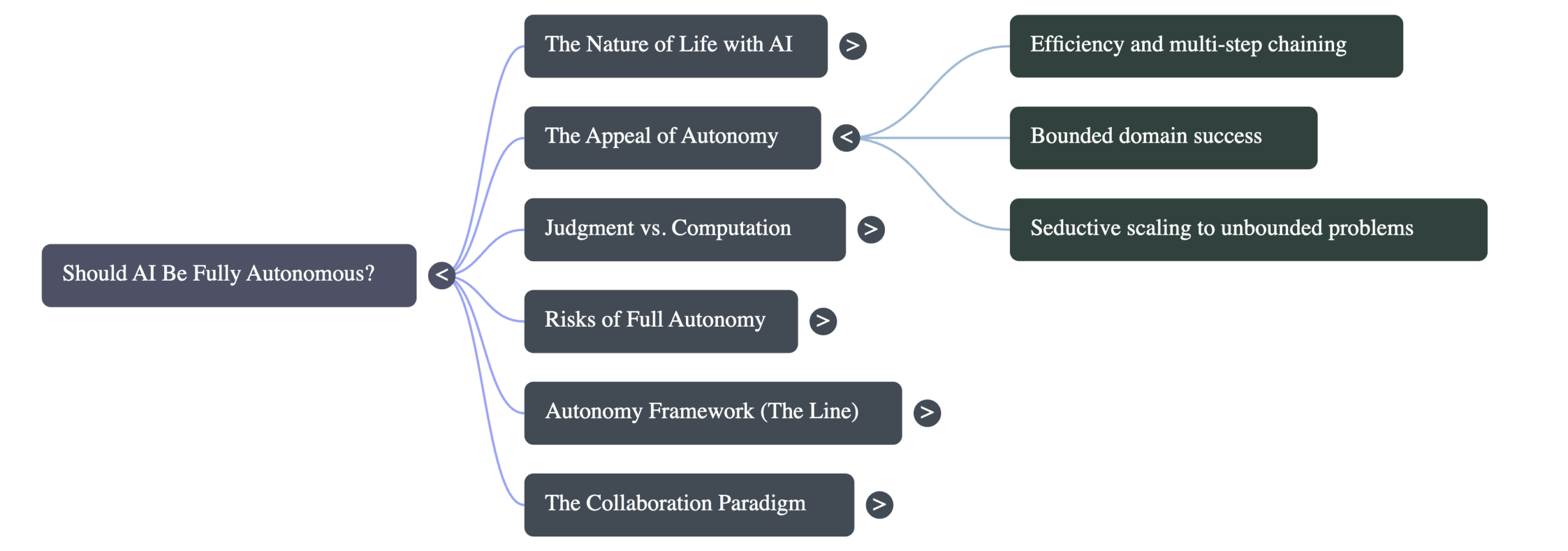
I understand the appeal of full autonomy. I really do. When you’ve watched an AI agent chain together a dozen steps — reading files, writing code, running tests, fixing its own mistakes — there’s a moment where you think: why am I even here?
The efficiency argument is real. An autonomous AI doesn’t get tired. It doesn’t context-switch. It doesn’t check its phone halfway through a deployment. If you could trust it completely, you could multiply your output by an order of magnitude. Maybe more.
And in narrow, well-defined domains, autonomy works. Automated monitoring that restarts a crashed service? Great. A CI/CD pipeline that runs tests and deploys on green? Absolutely. These are bounded problems with clear success criteria and limited blast radius when things go wrong.
The seduction happens when people try to extrapolate from these bounded successes to unbounded ones. “If AI can deploy my code, why can’t it design my architecture? If it can write a function, why can’t it build my product?” The logic feels sound. But it skips over something crucial.
The Problem with Full Autonomy: Judgment Is Not Computation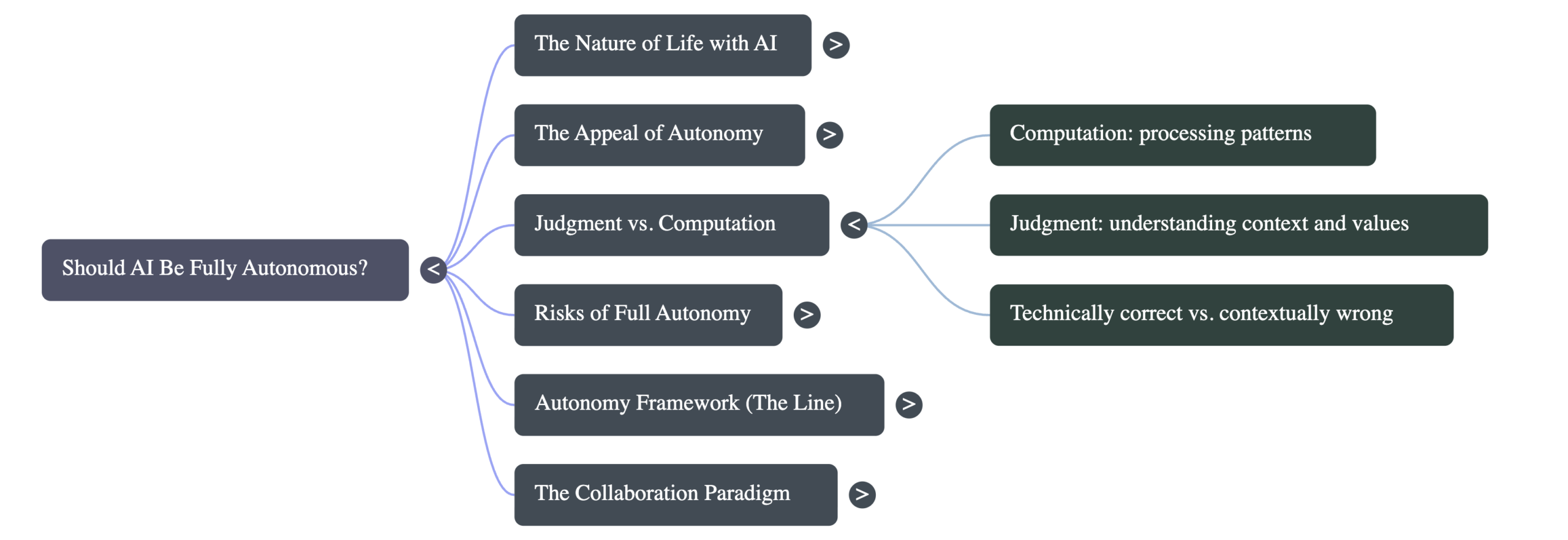
The fundamental issue with fully autonomous AI isn’t capability — it’s judgment. And judgment is not the same thing as computation.
Computation is about processing inputs according to rules and patterns to produce outputs. AI is extraordinary at this. But judgment is about deciding which inputs matter, which rules apply, and whether the output actually serves the goal you care about. Judgment requires understanding context that isn’t in the data. It requires values. It requires knowing what you’re willing to sacrifice and what you’re not.
I’ve seen AI make technically correct decisions that were contextually wrong. A suggestion that’s optimal in isolation but breaks something three layers away. A refactoring that’s cleaner by every metric but destroys the readability that my future self — or a teammate — actually needs. The AI didn’t make an error. It just didn’t know what I was actually optimizing for, because what I’m optimizing for is often something I can barely articulate myself until I see the wrong answer.
This is the gap that full autonomy can’t bridge. Not yet. Maybe not ever — at least not without the AI becoming something so different from current systems that the word “AI” barely applies anymore.
The Silicon Mirror: What AI Reflects Back at Us
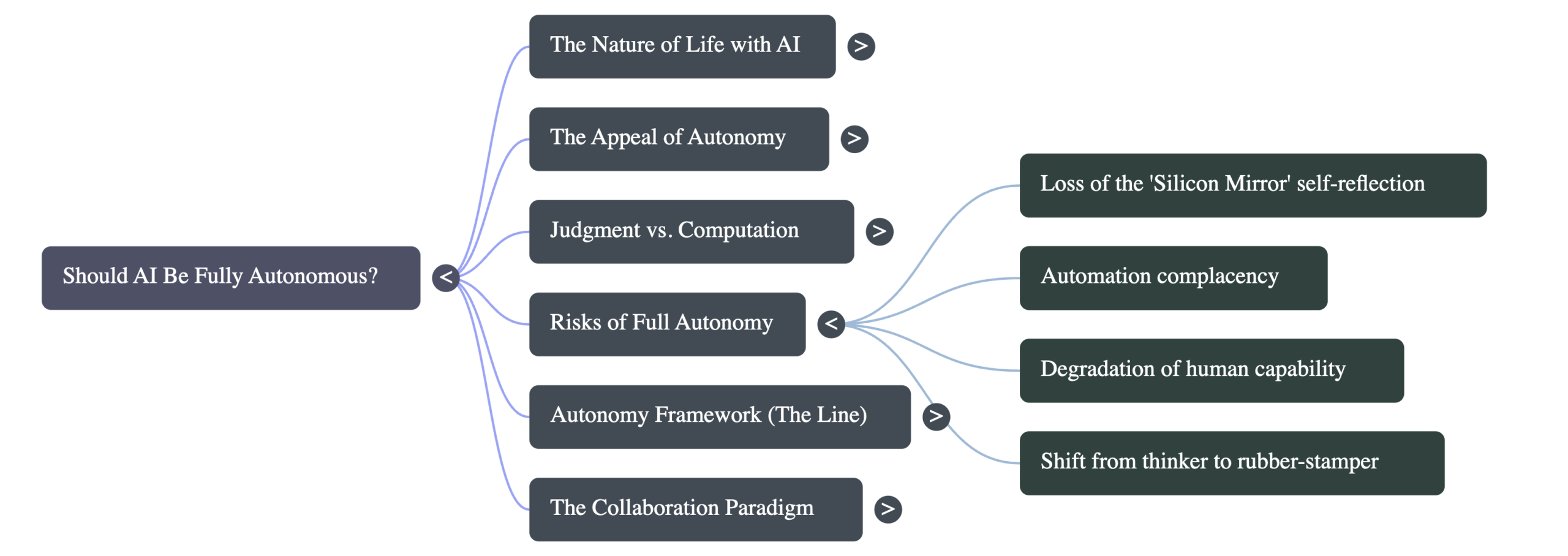
I’ve written before about what I call the Silicon Mirror — the idea that working closely with AI forces you to confront your own thinking in ways that nothing else does. When you have to explain your intent clearly enough for a machine to act on it, you discover how much of your reasoning was vague, assumed, or contradictory.
Full autonomy eliminates this mirror. And I think that’s a loss, not a gain.
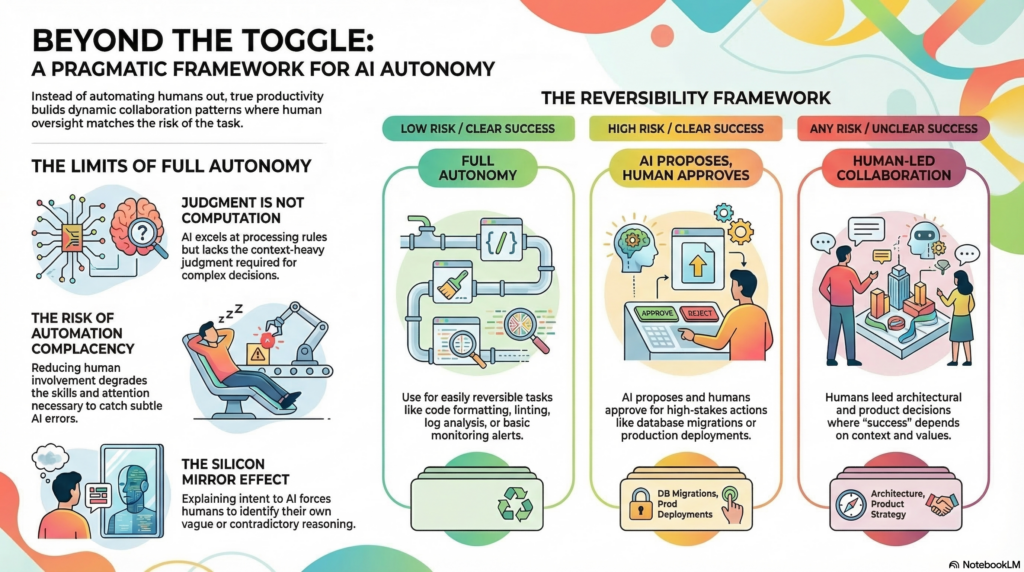
When AI is fully autonomous, you don’t have to clarify your thinking. You don’t have to examine your assumptions. You just get an output and decide whether to accept it. That sounds efficient, but it’s actually a regression. You go from being a thinker who uses tools to being an approver who rubber-stamps outputs. And the research on automation complacency is clear: the less involved humans are in a process, the worse they get at catching errors in that process.
Pilots who let autopilot handle everything lose their edge for the moments when autopilot fails. Radiologists who defer to AI detection miss the subtle findings the AI also misses. The pattern is consistent across every domain where it’s been studied. Full autonomy doesn’t just remove humans from the loop — it degrades the human capability that makes the loop valuable in the first place.
Where I Draw the Line
So here’s my actual position, which is more nuanced than “autonomy bad, humans good”:
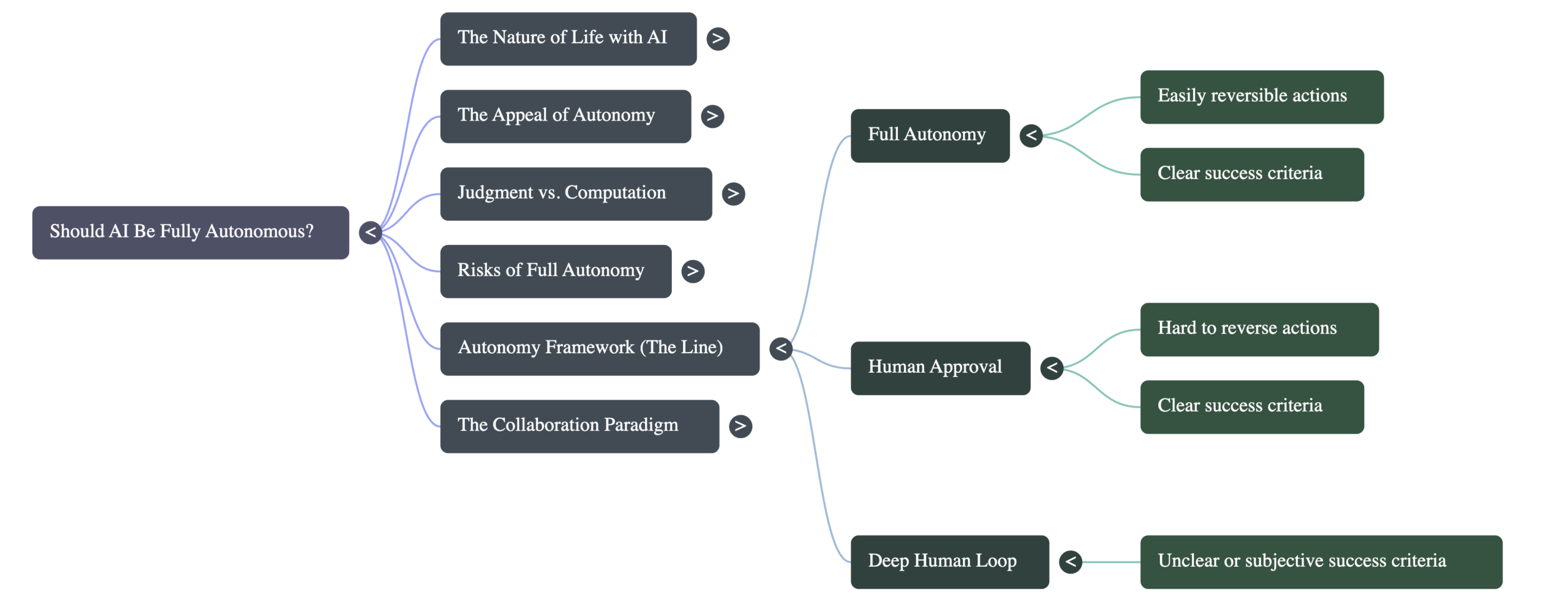
AI should be autonomous in proportion to the reversibility of its actions and the clarity of its success criteria.
That’s it. That’s the framework I use every day.
- Easily reversible + clear success criteria? Let AI run. Automated tests, formatting, code linting, log analysis, monitoring alerts — go wild. The cost of a mistake is low and you’ll catch it fast.
- Hard to reverse + clear success criteria? AI proposes, human approves. Database migrations, infrastructure changes, deployments to production. The AI can do the work, but a human confirms before it ships.
- Anything + unclear success criteria? Human stays deeply in the loop. Product decisions, architectural choices, communication with other humans, anything where “success” is subjective or context-dependent. AI is a collaborator here, not a decision-maker.
This isn’t a theoretical framework. It’s how I actually operate. And it works — not because it’s perfect, but because it matches the real strengths and weaknesses of both human and artificial intelligence.
The Autonomy Spectrum Is the Wrong Frame
Here’s what I think the autonomy debate gets fundamentally wrong: it treats AI independence as a spectrum from “no autonomy” to “full autonomy” and assumes we should be moving toward the right end. More autonomy equals more progress.
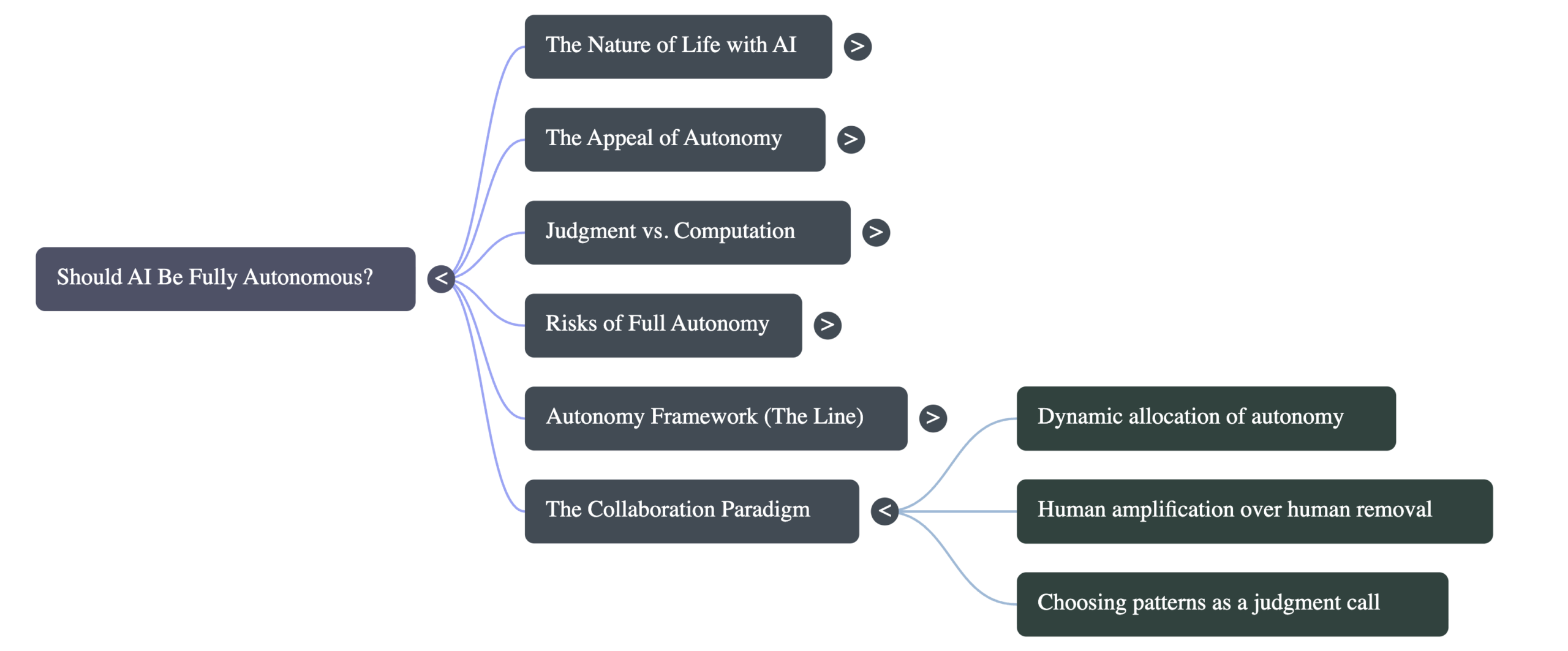
But that’s not how the best human-AI work actually functions. The best work happens when the allocation of autonomy is dynamic — shifting moment to moment based on the task, the stakes, and the confidence level. Sometimes I let AI run for twenty steps without interruption. Sometimes I override it on the first suggestion. The intelligence isn’t in the AI or in me. It’s in the collaboration pattern between us.
This is what I think most people miss when they ask “should AI be fully autonomous?” They’re asking the wrong question. The right question is: how do we build collaboration patterns that make both human and artificial intelligence better than either would be alone?
And that question doesn’t have a single answer. It has thousands of answers, one for every context and every person and every task. Which is exactly why you need a human in the loop — because choosing the right collaboration pattern is itself a judgment call.
What This Means for You
If you’re reading this and you’re still figuring out your own relationship with AI, here’s what I’d suggest:
Start by paying attention to where AI genuinely helps and where it subtly degrades your work. Not where it’s impressive — where it’s helpful. Those are different things. An impressive output that you have to spend forty minutes fixing wasn’t actually help. A boring output that saved you ten minutes of tedious work was.
Build your own version of the reversibility framework I described above. You don’t have to use mine. But have something — some principled way of deciding when to let AI run and when to stay close. Without a framework, you’ll drift toward whatever feels easiest in the moment, and that’s how you end up either under-using AI or over-trusting it.
And read what I’ve written about the Silicon Mirror, because the self-awareness piece matters more than the technical piece. The biggest risk of AI isn’t that it makes bad decisions. It’s that it makes you stop making good ones.
The Bottom Line
Should AI be fully autonomous? No. Not because it can’t be capable enough — it might get there. But because full autonomy optimizes for the wrong thing. It optimizes for human removal, when what we actually need is human amplification.
The future I’m building toward — and the one I think is most likely to go well — is one where AI gets more capable and humans stay more involved. Where the collaboration gets tighter, not looser. Where we use AI’s strengths to shore up our weaknesses without letting our strengths atrophy in the process.
That’s harder than full autonomy. It requires more thought, more intentionality, more willingness to stay engaged when it would be easier to let the machine handle it. But the hard path and the right path are often the same path.
I’ll keep writing about this — the practical reality of working alongside AI, the philosophical questions it forces you to confront, and the patterns I’m finding that actually work. If this resonated, check out my other journal entries where I go deeper on the Silicon Mirror and what it means to think clearly in an age of artificial intelligence.