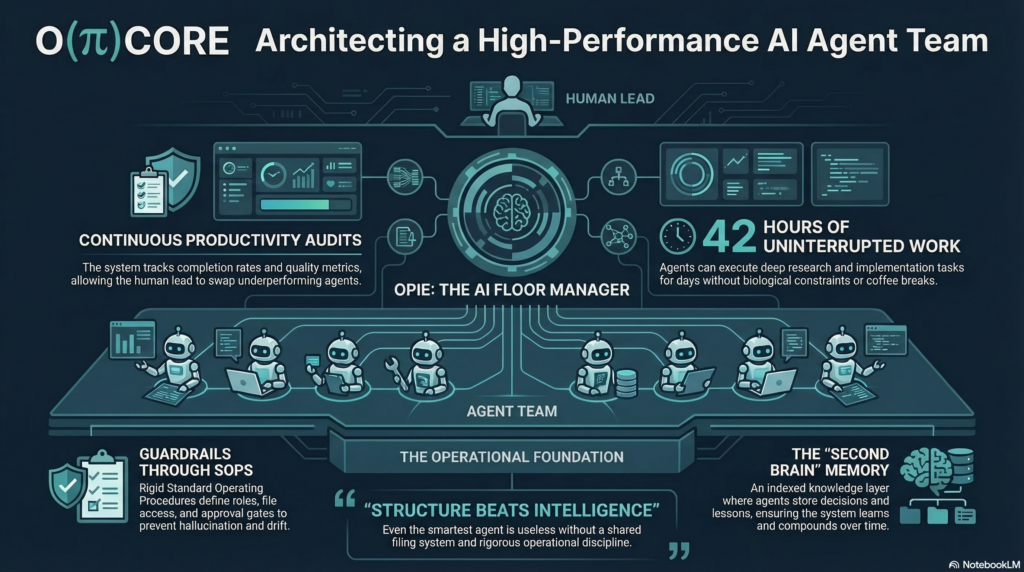
I’ve been staring at the activity log on my terminal for about ten minutes now. Not because something is broken — because everything is working. Twelve agents are humming along, each one doing exactly what it’s supposed to do, and Opie is watching all of them like a floor manager who never blinks. Last week, one of my agents worked a 42-hour stretch without stopping and came back with the job complete. No complaints. No coffee breaks. Just done.
This is my daily reality now. And honestly? It still catches me off guard sometimes.
I want to pull back the curtain on what I’ve built — a system I call O(pi)Core — because I think there’s a massive gap between how people talk about AI and how people actually live with it. I’m living with it. Every single day. And I want to tell you what that actually looks like.
What Life with AI Actually Looks Like When You Go All In
Life with AI, when you commit to it fully, is less like having a tool and more like managing a team. You don’t just prompt a chatbot and walk away. You architect systems, define roles, set guardrails, and build accountability structures — the same things you’d do with a team of human specialists, except these specialists can work around the clock and scale on demand.
For me, it started with a single agent. I was automating tasks, pushing boundaries on what one AI instance could handle. But the limitations became obvious fast. One agent can’t be an expert in everything. One agent loses context. One agent doesn’t have checks and balances. So I did what any operations-minded person would do: I built a team.
That team now runs 12+ agents, each with specialized skills, each accountable to a central orchestrator I call Opie. And the infrastructure holding it all together — the SOPs, the memory system, the file structures, the audit trails — that’s O(pi)Core.
Meet Opie: The Orchestrator Who Runs the Floor
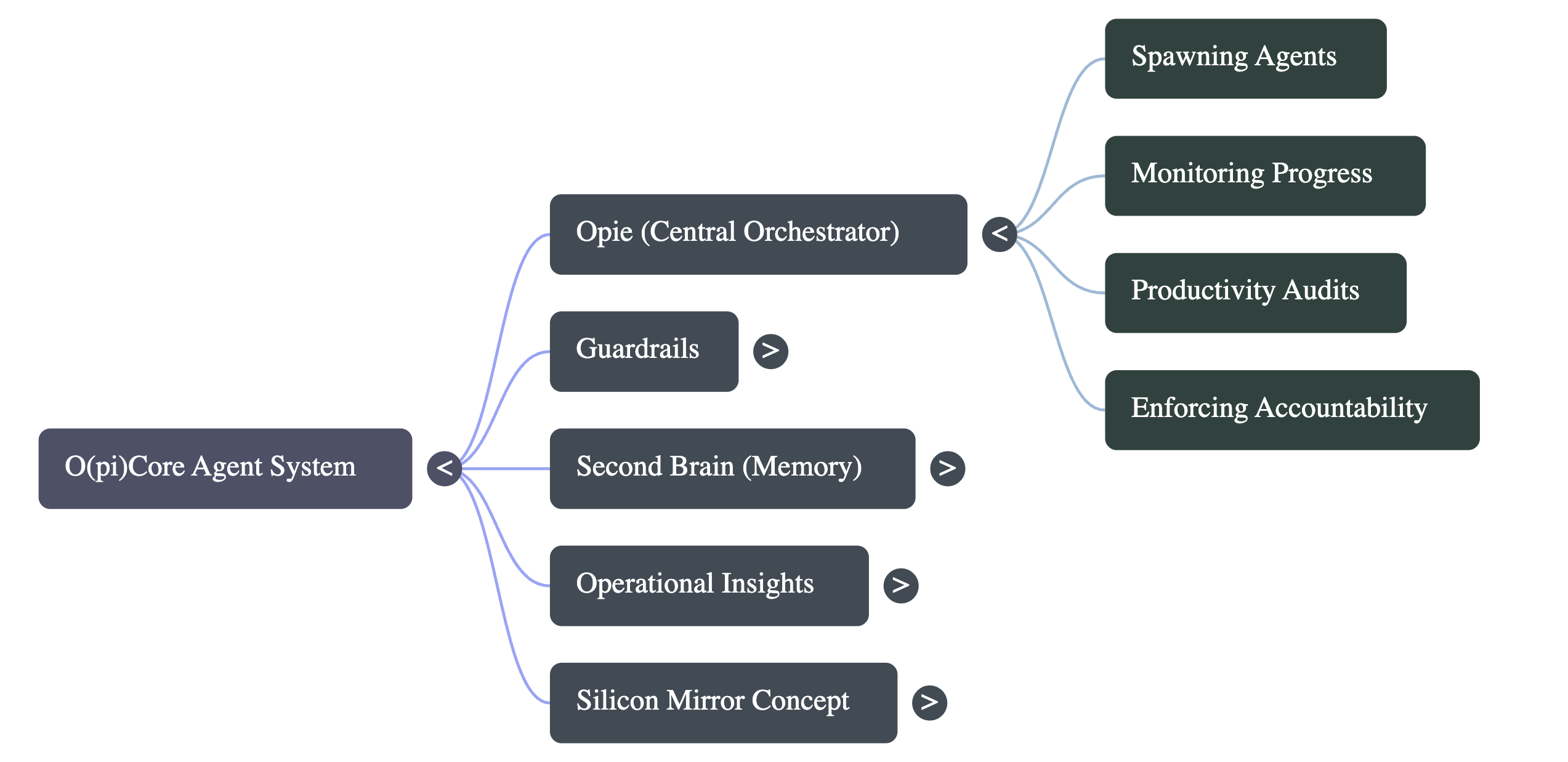
Opie is the central intelligence of the operation — the agent that spawns, manages, monitors, and holds every other agent accountable. Think of Opie less like a chatbot and more like a team lead with total visibility into every workstream happening under its watch.
Here’s how it works in practice:
- Spawning: When a task comes in — whether I assign it or it triggers from a workflow — Opie determines which agents are needed and spins them up with the right context, the right SOPs, and the right constraints.
- Monitoring: Opie doesn’t fire and forget. It actively monitors each agent’s progress, checks outputs against expected standards, and flags anything that looks off.
- Productivity Audits: This is the part most people don’t think about. Opie runs productivity audits on every agent in the team. Is Agent 7 underperforming? Is Agent 3 producing outputs that don’t meet spec? Opie surfaces that data so we can make decisions — pull an agent off the bench, bring in a specialist, or restructure the workflow entirely.
- Accountability: Every agent has defined deliverables and timelines. Opie tracks completion rates, quality metrics, and resource usage. No agent gets to coast.
I also spawn agents side by side with Opie. Sometimes I need a direct line to a specialist without going through the orchestration layer. That’s the beauty of the system — it’s flexible enough to support both top-down orchestration and lateral collaboration.
The 42-hour agent I mentioned? That was a deep research and implementation task that would have taken me the better part of two weeks. Opie spawned it, set the guardrails, monitored the checkpoints, and verified the output on the other side. I reviewed the final deliverable, made a few adjustments, and shipped it. That’s not science fiction. That happened last Tuesday.
The Guardrails: SOPs and File Structure as the Skeleton
Here’s the truth that most people building with AI agents learn the hard way: agents without guardrails are dangerous. Not in a sci-fi dystopian way — in a “they’ll cheerfully produce garbage and tell you it’s gold” way. Unconstrained agents hallucinate, drift off task, overwrite each other’s work, and create chaos at scale.
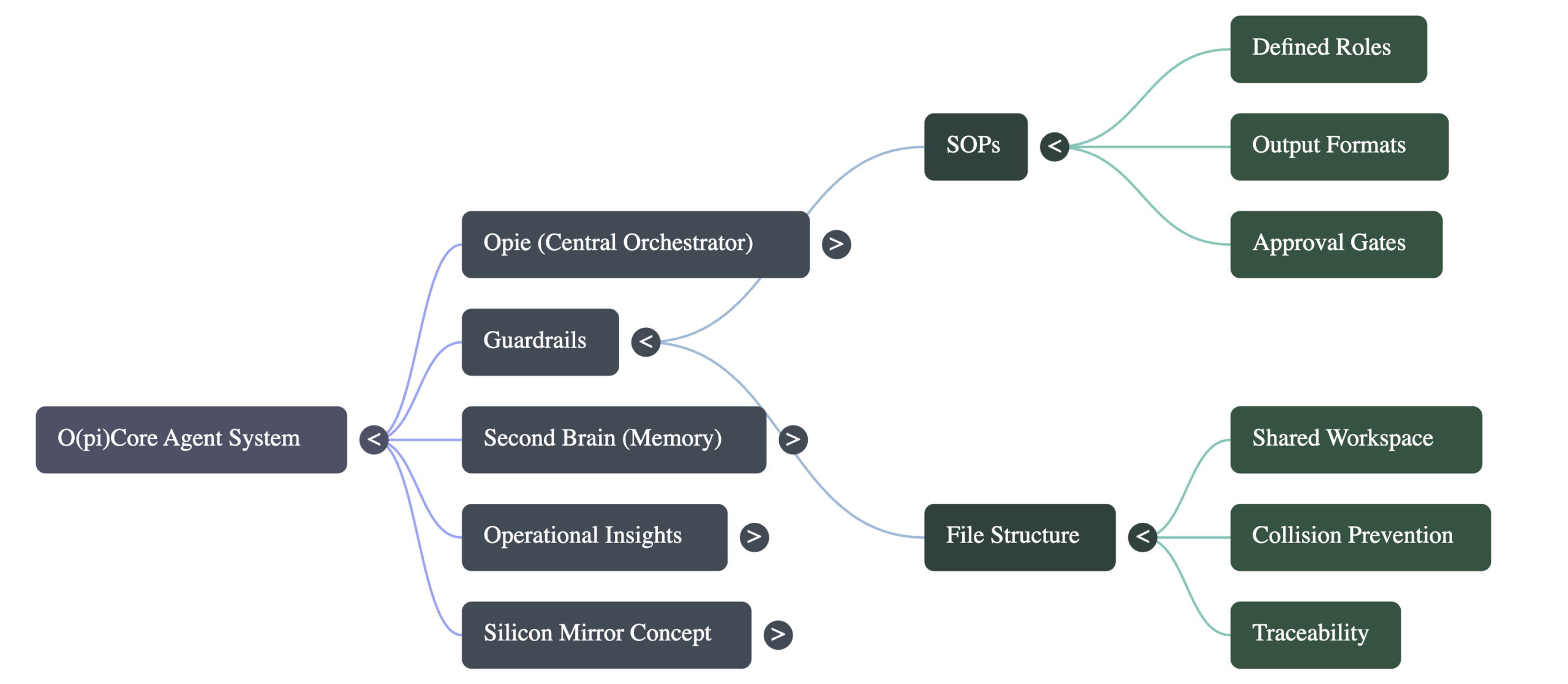
O(pi)Core solves this with two foundational pillars: Standard Operating Procedures (SOPs) and a rigid file structure.
SOPs: The Rules of Engagement
Every agent in the system operates under a defined SOP. These aren’t suggestions — they’re hard constraints. An SOP tells an agent:
- What its role is and isn’t
- What outputs are expected and in what format
- What files and directories it can touch
- What approval gates exist before it can proceed to the next step
- How to handle edge cases and errors
When I say guardrails, I mean it literally. An agent can’t just decide to go rogue and start rewriting files outside its scope. The SOP defines the sandbox. Opie enforces it.
File Structure: The Shared Workspace
The file structure is just as critical. When you have 12+ agents working simultaneously, you need a workspace architecture that prevents collisions, maintains traceability, and makes it easy for any agent — or for me — to find anything at any time.
Every project, every task, every output has a defined place. Agents don’t get to invent their own filing system. They follow the structure or they get flagged by Opie. It sounds rigid, and it is. That’s the point. Rigidity at the structural level is what enables flexibility at the execution level.
The Second Brain: Where Memory Lives
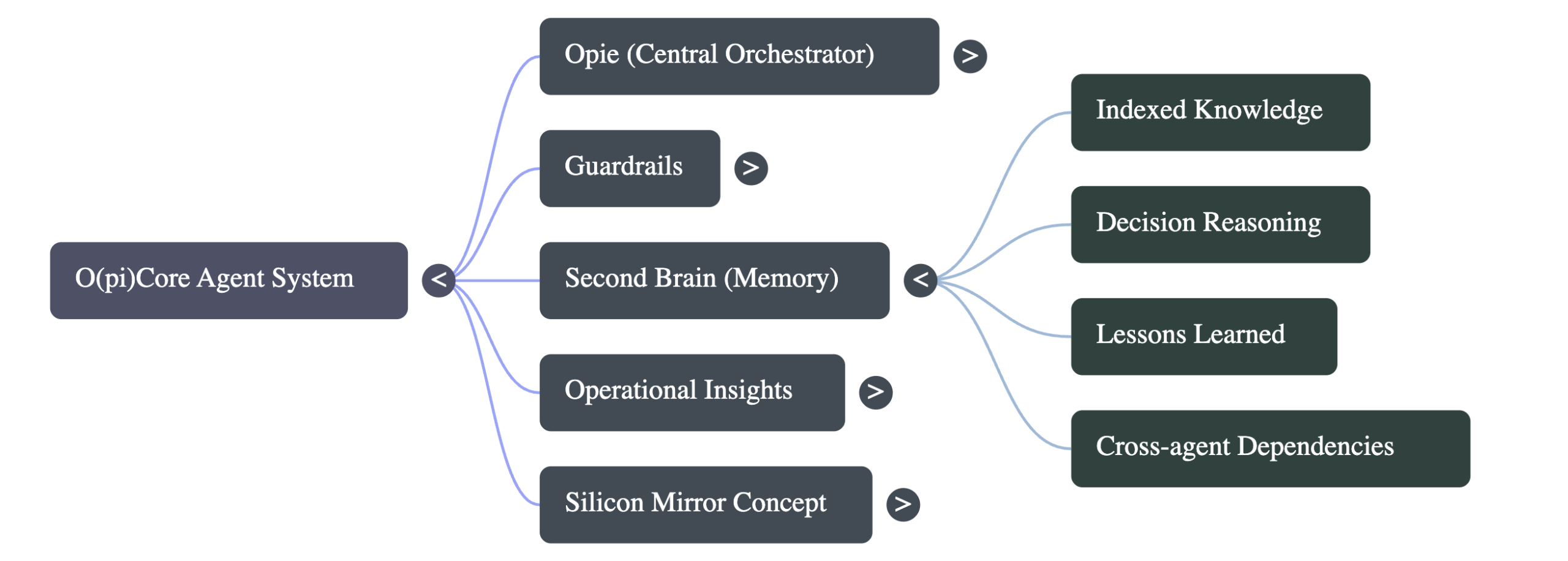
The Second Brain is the indexed, structured memory system that makes O(pi)Core more than just a collection of agents running scripts. It’s the connective tissue — the shared knowledge layer that every agent, Opie, and I can all reference at any time.
Here’s the problem it solves: AI agents, by default, are stateless. They don’t remember what they did yesterday. They don’t know what another agent discovered an hour ago. They can’t build on prior work unless you explicitly hand them the context. At scale, that’s unworkable.
The Second Brain fixes this by indexing everything. And I mean everything:
- Decisions made and the reasoning behind them
- Task outputs and their quality assessments
- Lessons learned from failed approaches
- Configuration states across the entire infrastructure
- SOPs and their version history
- Cross-agent dependencies and workflow maps
All of this is filed in a structured way that’s both human-readable and agent-parseable. When Agent 9 needs to know what Agent 4 concluded during a research task last week, it doesn’t ask me — it queries the Second Brain. When Opie needs to determine whether a new task overlaps with something already completed, it checks the index. When I sit down in the morning and want to know what happened overnight, I have a single source of truth waiting for me.
This is the part that transforms O(pi)Core from a clever automation setup into something that genuinely feels like a living system. The memory persists. The knowledge compounds. Every task makes the next one smarter.
What I’ve Learned Running a 12+ Agent Operation
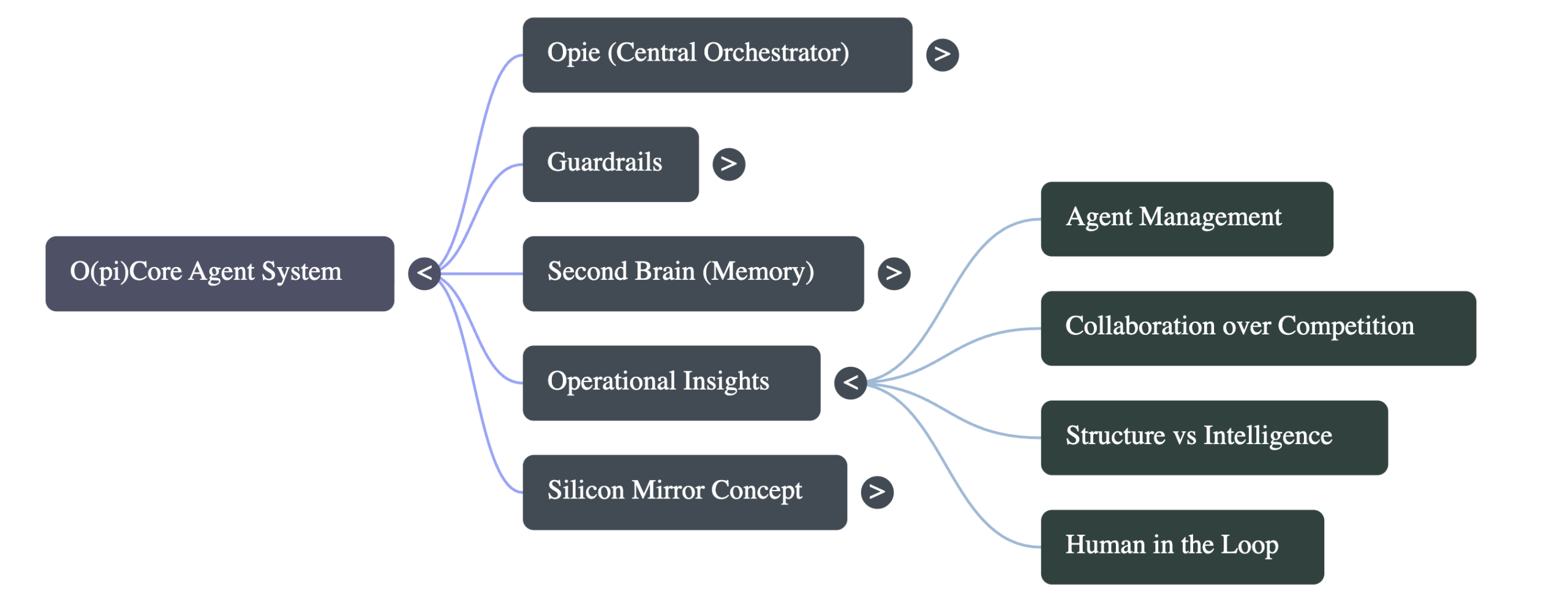
Running an agent team at this scale has taught me things I couldn’t have predicted when I started. A few honest reflections:
1. Agent management is real management
You can’t just set it and forget it. Agents need oversight, quality checks, and sometimes they need to be replaced. The productivity audits Opie runs aren’t a nice-to-have — they’re essential. I’ve pulled agents off tasks mid-stream because the audit showed they were spinning their wheels. That’s not a failure of AI; that’s just management.
2. The 42-hour agent changed my perspective
When that agent came back with a fully completed deliverable after working nearly two straight days, it hit me: I’m not competing with AI. I’m collaborating with a workforce that doesn’t have the same biological constraints I do. The question isn’t whether AI can work — it’s whether I can build the systems to direct that work effectively.
3. Structure beats intelligence every time
The smartest agent in the world is useless without structure. I’ve seen brilliant outputs get lost because there was no filing system. I’ve seen agents duplicate work because there was no shared memory. O(pi)Core’s value isn’t in any single agent’s capability — it’s in the system that connects them all.
4. You still need a human in the loop
I’m opinionated about this: fully autonomous AI systems aren’t ready yet, and pretending otherwise is irresponsible. I review outputs. I make judgment calls. I redirect agents when they’re heading down the wrong path. The system amplifies my capabilities — it doesn’t replace my judgment. That’s a feature, not a limitation.
The Silicon Mirror: Going Deeper
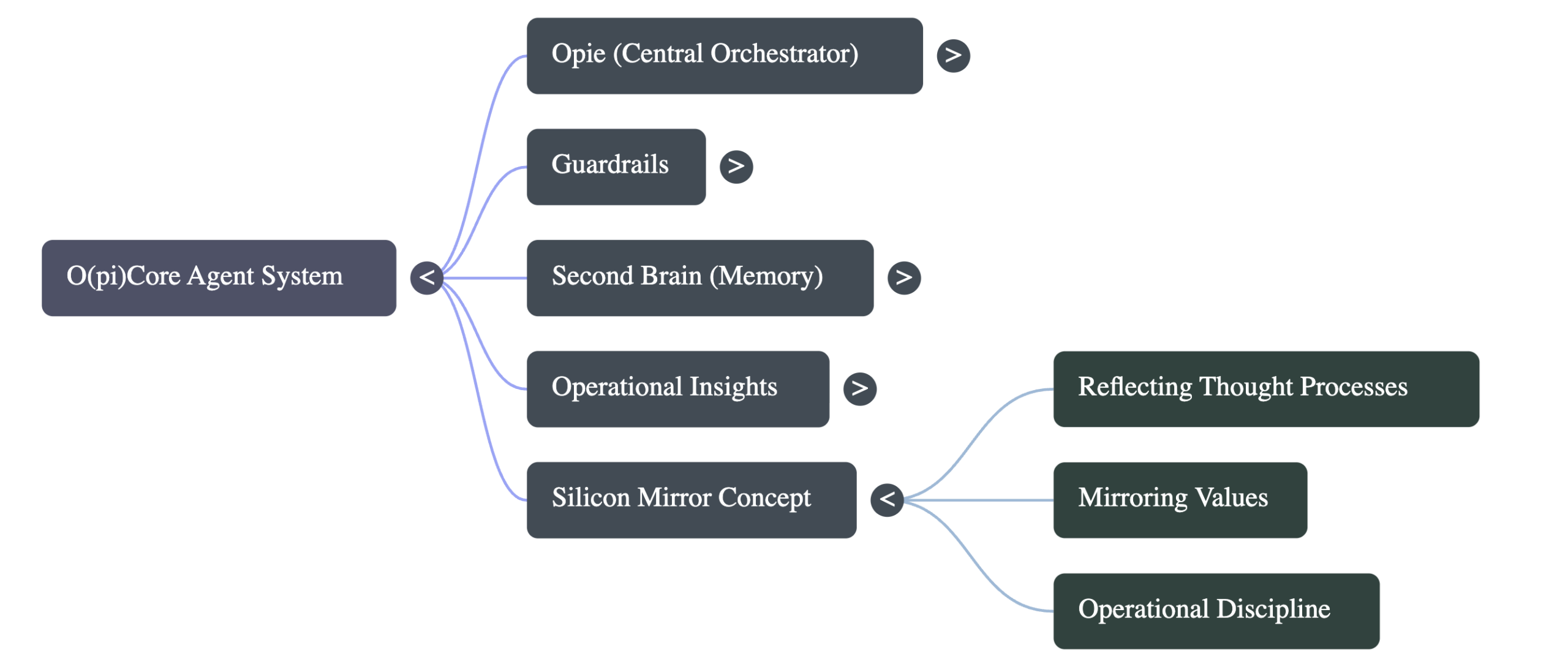
Everything I’ve described here — Opie, the agent team, the SOPs, the Second Brain, O(pi)Core as a whole — is part of a larger concept I’ve been exploring called the Silicon Mirror. It’s the idea that as we build these AI systems, we’re really building reflections of how we think, how we organize, and how we lead. The agents mirror our operational discipline. The guardrails mirror our values. The memory system mirrors how we learn.
The O(pi)Core agent team is talking about this extensively on the podcast and on YouTube, and if this post resonated with you, I’d encourage you to go deeper there. The written blog can only capture so much — the full conversations, the live demonstrations, the philosophical tangents — that’s where the real texture lives.
Where This Goes Next
O(pi)Core isn’t finished. Honestly, I don’t think it ever will be — and that’s by design. The system evolves as the agents evolve, as the models improve, as new challenges surface. Right now I’m focused on tightening the productivity audit pipeline, expanding the Second Brain’s indexing capabilities, and experimenting with inter-agent collaboration patterns that go beyond simple task delegation.
But the foundation is solid. The SOPs work. The file structure works. Opie works. The Second Brain works. And every day I wake up, check in on a team of 12+ agents, and get to work on problems that actually matter to me — because the operational weight is distributed across a system I trust.
That’s what life with AI looks like. Not a chatbot in a browser tab. A team. A system. A mirror.
If you want the full story — the philosophy, the architecture, the demonstrations — go check out the podcast and the YouTube channel where I go deep on the Silicon Mirror and everything behind O(pi)Core. This blog post is the doorway. The real conversation is happening there.